
The world of associations is changing rapidly. Traditional operational methods, such as relying on prospective members to understand the value of your association, having one source of revenue stream, assuming member loyalty, and making decisions based on intuitions, are no longer enough for association success. As millennials, Generation Z, and diverse audiences become predominantly new targets for members, associations must understand the shifting member expectations. Adding on top, the need to create a 360-degree satisfactory member experience, while managing a shrinking budget, associations are usually struggling with a lack of resources, skills, and data to execute and reach their annual goals – lo and behold an operational gap is created. The big question is, how do associations navigate successfully toward growth?
Driving Association Success with the Continuous THRIVE Model
Enter the Continuous THRIVE Model, a growth framework specifically designed for associations by Direct Objective Consulting, a Canadian B2B marketing consulting firm with a 20-year history of working alongside multiple prominent associations. The model equips associations with the tools to achieve sustained success by focusing on technology, data, revenue diversity, inclusion, value sharpening, and engagement. “Is this applicable to our association? How can it benefit us?”, you might be asking. The short answer to the first question is a resounding yes. Now, let’s dive into the latter by breaking down the framework and exploring how it can benefit organizations like yours.
The Continuous THRIVE Model at a Glance
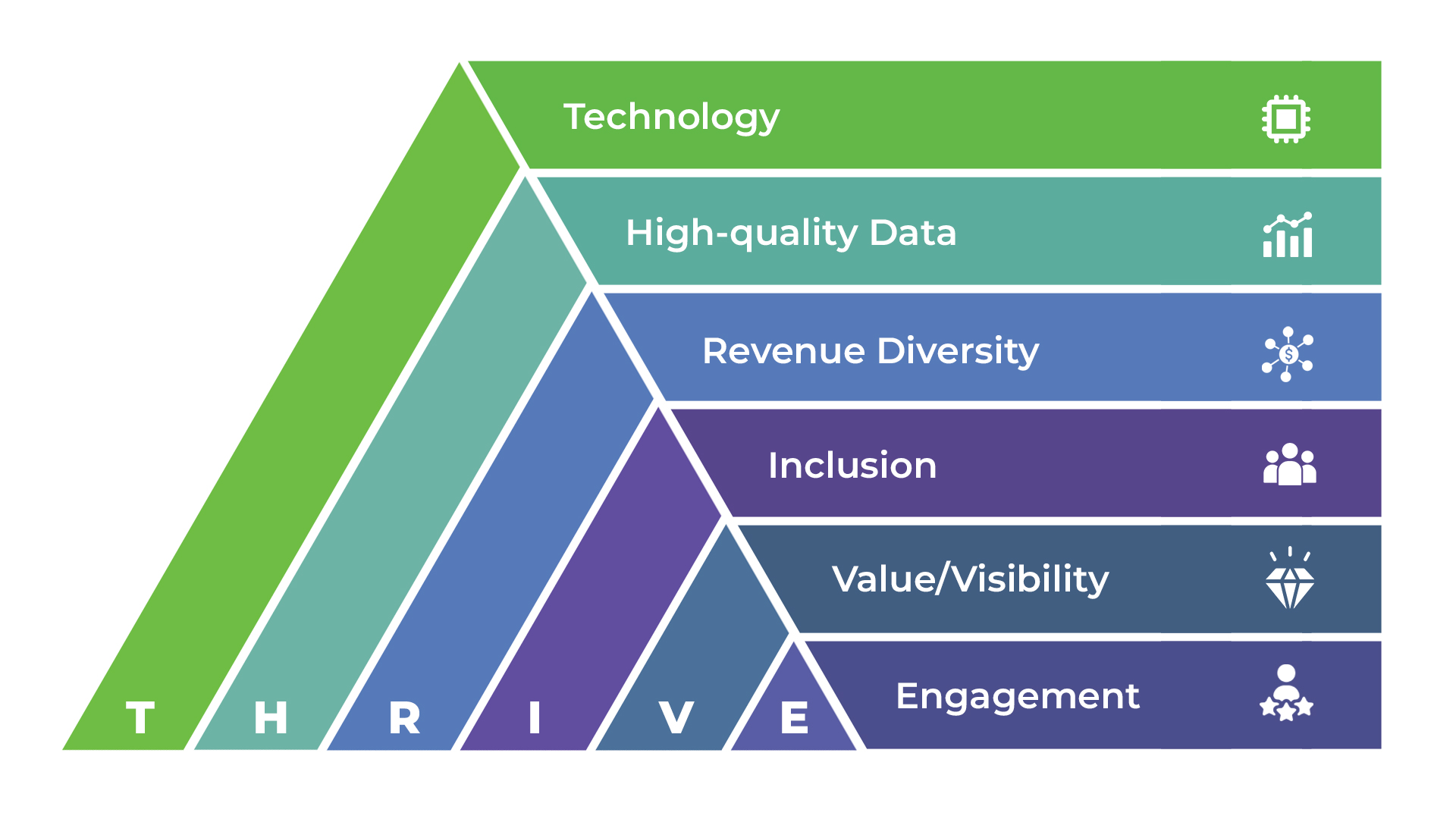
The Continuous THRIVE Model provides a roadmap for associations to overcome operational gaps and embrace continuous growth. It is based on six key components: Technology, High-Quality Data, Revenue Diversity, Inclusion, Value, and Engagement.
Here’s how each element contributes to the model and the association success it promises:
- Technology (T): If selected and integrated correctly, incorporating cutting-edge automation tools improves agility. From AMS to CRM systems, through AI, technology can drive efficiency, productivity, and scalability.
- High-Quality Data (H): Evolving to KPIs that represent your association’s directions and innovative data collection methods allow associations to make informed decisions faster and more accurately. This isn’t about data for the sake of data, it’s about actionable insights and smarter decision-making.
- Revenue Diversity (R): Diversifying income streams ensures financial stability and reduces overreliance on dues. Develop non-dues revenues that not only secure your organization’s viability but also enhance the value perception and members’ loyalty.
- Inclusion (I): Collaboration is the foundation of resilience. Including diverse voices from all your stakeholders (i.e., members, lapsed members, employees, sponsors) fosters innovation and builds stronger communities.
- Value/Visibility (V): Sharping and quantifying the unique value of your association enables you to design a member journey paved with value-enhancing experiences that constantly remind members about the important role of your association, enhancing member satisfaction, visibility, and retention.
- Engagement (E): Identify the areas where your association can demonstrate the added value for each member. Educate, entertain, and engage them. Measure it. Sustained member engagement leads to better retention, a stronger sense of community, and more opportunities for growth.
How the Continuous THRIVE Model Drives Association Success
Most associations have different levels of strategy in place, but their execution:
-
- is usually under-budgeted
- is not always in sync with the organization’s goals and value
- takes longer to make the transitions
- relies on insufficient data or does not have the capability to analyze it
- is focused on operations, not on engagement
- is not designed to address new feedback from stakeholders
- requires skills and resources that are not regularly available in-house
Does the Continuous THRIVE model apply to a certain industry or sector?
No, the Continuous THRIVE model is industry-agnostic. While it was originally created for B2B businesses and associations, its principles are broad and flexible enough to apply to any industry or sector, from tech companies to healthcare providers, membership associations to retailers, manufacturers, and more.

The Continuous THRIVE model can guide associations and not-for-profit associations in a variety of ways:
-
Defining and Quantifying Unique Values
These days, many associations struggle to articulate the specific value they provide or demonstrate it clearly to their target audience. This can result in member attrition or difficulty attracting new members, especially with the demographic shifts. The Continuous THRIVE Model helps you pinpoint, adjust, and quantify the benefits you deliver, clearly communicating the immediate benefits of being a member.
-
Exploring New Avenues for Financial Growth
Membership dues are the lifeblood of most associations. But what happens during periods of economic downturn or disruption like the one that we experienced during the COVID pandemic? The Continuous THRIVE model paves the way to diversifying revenue streams through online courses, and innovative sponsorship schemes. This creates a financial buffer against uncertainty while building opportunities for higher engagement and growth.
-
Enhancing Operational Agility
Associations often struggle with replacing inefficient processes or resistance to change. The Continuous THRIVE Model streamlines operational agility, enabling your team to adapt gradually to new challenges and opportunities, through built-in flexible procedures and streamlined workflows. This enables your team to follow procedures on one hand and on the other hand allows you to make constant slight adjustments that will be reflected in the procedures whether done automatically or by an employee.

-
Customizing Data and KPIs for Precision
One-size-fits-all metrics don’t cut it anymore. Your association needs KPIs that reflect your unique goals and challenges. By focusing on high-quality data, you’ll gain insights into member behaviour, program performance, and operational efficiency. All of these will equip your organization to get the faster, and smarter decision-making you need for association success.
-
Ensuring Collaborative Resilience
No organization can succeed when they work in a silos. By fostering collaboration among staff, members, and stakeholders, you create a more resilient structure for future challenges. Collaboration also opens the door to fresh ideas and innovation—essential elements for association success.
-
Focusing on Engagement and Retention
Retention is the backbone of an association’s success as retaining existing members is dramatically more cost-effective than acquiring new ones. However, many organizations fail to prioritize it adequately. As a result, their recruitment efforts often resemble a revolving door: new members join, only for existing members to exit just as quickly.
Engagement goes even beyond retention. It’s about creating a community that members want to be part of, where they feel valued and inspired to contribute. The more your members are engaged with your programs, the more likelihood that they stay with your association for a longer period, thus higher Life Time Value (LTV).
The Continuous THRIVE Model helps associations identify weak operational areas and missing links in the member journey, and address them at every touchpoint, ensuring maximum member engagement.

Taking the Next Step
By embracing these principles, you can position your organization for long-term success while meeting the immediate needs of your members and stakeholders. If you are curious to learn more about real case studies of how it has helped organizations thrive, you can visit here.
Are you ready to drive association success? Download our whitepaper, “Bridging the Operational Gap and Driving Growth”, to learn more about implementing the Continuous THRIVE Model in your organization.